
In This Article
There’s a special kind of betrayal reserved for the first deep freeze of the year. It’s 2 a.m., you open the app expecting a crisp view of the driveway, and you get a grey “offline” tile instead. The camera shrugged off July thunderstorms like a champ. January? Not so much.
Here’s the uncomfortable truth: most outdoor cameras are built to survive rain, not winter. Choosing a weatherproof outdoor camera for extreme cold climates means reading three things that glossy product pages like to bury: the operating temperature range, the IP rating, and what powers the camera when the thermometer nosedives.
This guide breaks down seven real cameras, from an AA-powered budget pick to wired PoE models rated to -22°F. I haven’t tested any of them, and I won’t pretend otherwise. What you’ll get is an honest analysis built on manufacturer specs, retailer listings, and aggregated reviewer sentiment checked in October 2026. Prices appear as ranges only, so always check the current price before you buy.
Along the way you’ll find a plain-English look at the IP66 weather rating, a hard look at lithium battery cold performance, and a winter setup plan. If you’re hunting for a freezeproof outdoor security camera for winter, or an outdoor camera that works in subzero temperatures, the table below is your fast lane.
What Is a Weatherproof Outdoor Camera for Extreme Cold Climates?
A weatherproof outdoor camera for extreme cold climates is a security camera with a sealed housing against dust and water, plus electronics rated to keep working well below freezing, ideally -4°F (-20°C) or lower. The published temperature rating matters more than the word “weatherproof” on the box.
The sealing part follows the IEC 60529 IP Code, a two-digit system where the first digit covers solids and the second covers liquids. The cold part is a separate spec entirely. Reolink’s own buyer’s guide notes that many standard outdoor cameras are rated from about -10°C (14°F), while specialized cold-weather models handle -30°C or lower. A camera can be superb at shedding water and still sulk at 5°F. Keep those two ideas apart and the rest of this guide gets much easier.
Quick Comparison: 7 Cold-Rated Outdoor Cameras at a Glance
| Camera | Power | Lowest Rated Temp | Weather Rating | Best For |
|---|---|---|---|---|
| Amcrest IP8M-T2599EW | PoE or 12V DC | -22°F (-30°C) | IP67 | Permanent installs in deep-freeze zones |
| Lorex E841CA-E | PoE | -22°F (-30°C) | IP67 | Households already on a Lorex NVR |
| Reolink RLC-810A | PoE or 12V DC | 14°F (-10°C) | IP66 (some retailers list IP67) | Budget 4K wired coverage in moderate cold |
| Eufy SoloCam S340 | Battery plus built-in solar | -4°F (-20°C) | IP67 | Wire-free pan-and-tilt coverage |
| Arlo Pro 5S | Rechargeable battery (solar optional) | -4°F (-20°C) | Weather-resistant (no IP code found in my research) | Polished app, subscription-friendly buyers |
| Blink Outdoor 4 | 2 AA lithium batteries | -4°F (-20°C) | Weather-resistant (IP code not verified) | Low-maintenance, budget wire-free |
| Reolink Argus 4 Pro | 5,000 mAh battery plus 6W solar | 14°F (-10°C) | IP66 | Wide 180° view on sunny winter sites |
Look at the “Lowest Rated Temp” column first. Only the two wired PoE models from Amcrest IP8M-T2599EW and Lorex E841CA-E are rated to -22°F, and that’s not a coincidence: no battery means no cold-sensitive chemistry to babysit. The wire-free options cluster at -4°F, which is fine for most of the country but thin for the northern tier. Meanwhile Reolink RLC-810A and Reolink Argus 4 Pro carry a 14°F floor, so they suit milder winters or sheltered spots.
💬 Just one click — help others make better buying decisions too!😊
Top 7 Weatherproof Outdoor Cameras for Extreme Cold Climates: Expert Analysis
I’ve ordered these roughly from coldest-rated to most cold-sensitive, because in a deep freeze the rating is the whole game. Every spec below comes with what it means on your actual wall, in your actual January.
1. Amcrest IP8M-T2599EW — rated to -22°F without drama
If a cold snap has ever scared you, this is the spec sheet to tape to the fridge.
This 4K (8MP) turret camera lists an operating range of -22°F to 140°F, an IP67 housing, and PoE or 12V DC power at roughly 7 watts. Translation: it’s built to sit through a Minnesota January with no battery to complain about. Because Power over Ethernet carries data and power down one cable, there’s no lithium chemistry in the equation at all. IP67 covers brief submersion, which is more than snowmelt will ever ask.
Based on the spec comparison, this is the stronger pick for a permanent install where you can pull Ethernet and want real margin between the rated limit and your coldest night. The trade-off is the classic wired one: someone has to run cable, and you’ll need a PoE switch, injector, or compatible NVR.
Reviews: I couldn’t verify enough aggregated owner feedback for this exact model to summarize it honestly, so lean on the spec sheet and check the current review pool.
Pros:
- ✅ Lowest cold rating in this lineup
- ✅ One-cable PoE power and data
- ✅ 4K detail with microSD slot
Cons:
- ❌ Needs an Ethernet run and PoE source
- ❌ No battery or solar flexibility
Expect roughly $90–$140. For a deep-freeze install, that margin is hard to beat.
2. Lorex E841CA-E — all-metal 4K built for the cold
The Lorex E841CA-E matches the -22°F floor with a heavy aluminum housing and an IP67 rating, which is why it keeps showing up in northern-climate conversations.
It’s a 4K (8MP) IP camera with a 105° field of view, HDR, color night vision, and a rated range of -22°F to 140°F. That HDR matters more than it sounds: fresh snow turns a scene into a glare bomb, and a sensor that balances bright and dark areas keeps faces and license plates readable. The 105° view comfortably covers a driveway or porch.
My analytical take: this is the natural choice if you already own, or plan to buy, a compatible Lorex NVR, since it’s built to pair with select Lorex recorders. Lorex’s own product Q&A suggests using a Lorex PoE switch to power it, so check power compatibility before mixing in third-party gear.
Reviews: I couldn’t verify a trustworthy review pool for this exact model, so I won’t summarize one. Check current ratings before purchase.
Pros:
- ✅ -22°F rating with metal construction
- ✅ HDR helps with snow glare
- ✅ No monthly fees required
Cons:
- ❌ Works best inside the Lorex ecosystem
- ❌ Requires a wired PoE setup
Plan on around $90–$150. Strong value if the Lorex ecosystem already lives in your closet.
3. Reolink RLC-810A — budget 4K PoE for moderate-cold winters
This one is the thrifty wired choice, with an honest asterisk about the cold.
The Reolink RLC-810A records 4K (3840×2160) at 25 fps, with infrared night vision to roughly 100 feet. Its rated range is -10°C to 55°C (14°F to 131°F). Spec sheets list IP66, while Reolink’s own review page says IP67, so confirm the listing you’re buying. Power comes from PoE or a 12V adapter, and neither is in the box. It’s Ethernet only, with no Wi-Fi.
That 14°F floor works for much of the U.S., but if your lows regularly hit -15°F, you’re running past the rating. Reolink’s own cold-weather guide mentions a customer who ran a different PoE model at -45°C, which is a fun anecdote and a terrible basis for a purchase. Rated limits are what the manufacturer will stand behind.
Reviews: One retailer listing shows 4.8 stars from only 19 ratings, a small sample but positive.
Pros:
- ✅ 4K detail at a budget price
- ✅ Wired power avoids battery issues
- ✅ Person and vehicle detection
Cons:
- ❌ Rated floor is only 14°F
- ❌ PoE injector or adapter not included
Roughly $60–$100. Great value, as long as your winters stay inside its rated range.
4. Eufy SoloCam S340 — dual-lens pan-tilt with built-in solar
Wire-free, no monthly fee, and the solar panel is built into the body.
The Eufy SoloCam S340 pairs a 3K dual-lens system (wide-angle plus tracking) with a rated range of -4°F to 122°F and IP67 protection. It stores clips on 8GB of onboard storage, so there’s no ongoing subscription cost. Eufy says its panel collects 600–800 mAh per day under optimal sunlight. In a gray northern December, “optimal sunlight” is a rumor, so treat the solar as a top-up rather than a lifeline.
Who’s it for? Someone who needs wide coverage without drilling through walls and whose winters rarely dip below the -4°F line. Pan-and-tilt means one unit can sweep a yard that would otherwise take two fixed cameras.
Reviews: A European retailer lists 4.4 stars from 34 ratings. That’s a thin sample, and I couldn’t verify deeper winter-specific sentiment.
Pros:
- ✅ IP67 with a -4°F cold rating
- ✅ Pan-tilt covers a wide area
- ✅ Local storage, no required subscription
Cons:
- ❌ Solar contribution shrinks on short gray days
- ❌ 2.4 GHz Wi-Fi only
Typically $140–$200. A solid wire-free pick for the moderate-cold crowd.
5. Arlo Pro 5S — polished app, 160° view, built-in spotlight
The Arlo Pro 5S is the “it just works” option, as long as you’re comfortable with a subscription.
It delivers 2K HDR video, a 160° field of view, color night vision, and a built-in spotlight, with an operating range of -4°F to 113°F in a weather-resistant body. It works with Alexa, Google Assistant, Apple Home, and SmartThings, which is rare. Cloud recording requires a paid Arlo Secure plan after the trial.
Think of that -4°F figure as a floor, not a goal. In an Arlo community thread about an earlier Arlo Pro model, users reported shutdowns right around -4°F. That’s a different generation, so it’s a caution rather than a verdict on this camera.
Reviews: One retailer listing shows 4.3 stars from 48 reviews.
Pros:
- ✅ Sharp 2K HDR with 160° view
- ✅ Spotlight and color night vision
- ✅ Broad smart-home compatibility
Cons:
- ❌ Full features need a paid subscription
- ❌ Little margin below the -4°F floor
Typically $100–$180. Worth it if you value the app and ecosystem over cold margin.
6. Blink Outdoor 4 — two AA lithium cells, up to two years
The Blink Outdoor 4 wins the “forget about it” category.
It records 1080p with a 143° diagonal view, runs on two non-rechargeable AA lithium batteries, and lists -4°F to 113°F. Blink estimates up to two years per set under standard use, and one reviewer reported well over a year, including winter snowstorms. The camera connects through a Blink Sync Module.
Why lithium AAs matter: guides for Blink cameras consistently recommend them over alkaline, which sag faster in cold, and Blink advises against rechargeable NiMH cells. That’s practical lithium battery cold performance in action. Primary lithium cells simply hold their output better when it’s freezing.
Reviews: The aggregated sentiment I found is favorable on battery longevity, though most coverage is not winter-specific.
Pros:
- ✅ Swap batteries in about a minute
- ✅ Very long battery life
- ✅ Lowest cost of the group
Cons:
- ❌ 1080p is the lowest resolution here
- ❌ Disposable cells, no cold margin below -4°F
Roughly $60–$110. A smart low-maintenance buy for moderate winters.
7. Reolink Argus 4 Pro — 180° dual-lens view with solar
Two 4K lenses stitched into one 180° picture: a whole side of your property from one mount.
The Reolink Argus 4 Pro carries a 5,000 mAh built-in battery, an IP66 housing, Wi-Fi 6, and a 6W solar panel for top-ups. Its rated range is -10°C to 55°C (14°F to 131°F). The battery isn’t user-replaceable, so a failure means a support ticket, not a trip to the drawer.
Winter is where this camera gets honest. One comparison site lists 3.9 stars from 634 ratings and flags winter battery as a weak spot. A German test found the battery lasted just under a month without solar and called the panel a must-have. On the plus side, one Canadian user on Reolink’s community forum reported steady operation at -30°C (-22°F) and colder, an anecdote far beyond the rated range, not a promise.
Pros:
- ✅ 180° dual-lens 4K coverage
- ✅ IP66 with solar top-up
- ✅ Low-battery alert at 10 percent
Cons:
- ❌ Built-in battery can’t be swapped
- ❌ 14°F rated floor and weak winter solar
Typically $120–$200 with the panel. Best on a sunny wall with milder lows.
Top 7 Round-Up: Specs, Price Ranges, and Fit
| Camera | Video | Price Range | Storage / Subscription Note | Best For |
|---|---|---|---|---|
| Amcrest IP8M-T2599EW | 4K (8MP) | $90–$140 | microSD slot | Deep-freeze fixed installs |
| Lorex E841CA-E | 4K (8MP) | $90–$150 | SD slot (see spec sheet) | Lorex NVR households |
| Reolink RLC-810A | 4K (8MP) | $60–$100 | microSD up to 256GB | Budget wired 4K |
| Eufy SoloCam S340 | 3K dual lens | $140–$200 | 8GB onboard | Solar-assisted pan-tilt |
| Arlo Pro 5S | 2K HDR | $100–$180 | Cloud (paid plan after trial) | App polish and ecosystem |
| Blink Outdoor 4 | 1080p | $60–$110 | Sync Module hub | Low-maintenance wire-free |
| Reolink Argus 4 Pro | 4K dual lens | $120–$200 | microSD slot | Wide-view solar setups |
Prices are approximate ranges and change often, so check current prices before deciding. The pattern across the table is clear: the cheapest camera in each power class tends to be the one with the weakest cold margin. Reolink RLC-810A is the value leader among wired models, while Blink Outdoor 4 takes that title for wire-free. If budget isn’t your constraint, Amcrest IP8M-T2599EW and Lorex E841CA-E buy you the most cold-weather headroom per dollar.
Winter Setup and Maintenance Guide: Your First 30 Days
A good camera installed badly is just an expensive ornament. These steps cost almost nothing and prevent most winter headaches.
Week one: placement and sealing.
- Mount under an eave or overhang, roughly 8–10 feet up, so the camera dodges direct rain, snow, and glare.
- Leave a drip loop in every cable so meltwater drips off instead of tracking into the connector.
- Use the weatherproof connector cover that comes with wired cameras, and seal unused ports.
Week two: power and batteries.
- For Blink Outdoor 4, use lithium AAs only. Alkaline cells fade faster in the cold, and NiMH isn’t recommended.
- For Reolink Argus 4 Pro and Eufy SoloCam S340, tilt the solar panel steeply so snow slides off, and brush it clear after storms.
- Limit live viewing on battery models. Streaming keeps the camera fully awake and drains cells quickly.
Week three: cold-start habits.
- If a camera has been stored below its rating, let it warm up indoors with the power off before powering it on, a tip from a security-industry guide.
- Check battery status monthly through winter.
Week four: check your real lows.
- Compare your coldest forecast against the camera’s rating. The National Weather Service wind chill chart describes how cold exposed skin feels, not a temperature your device reaches, so judge by air temperature.
Common mistakes in the first 30 days: mounting in direct afternoon sun on a snowy wall, skipping the drip loop, and trusting a “weatherproof” label with no numeric cold rating. Fix those three and you’ve dodged most winter callouts.
Real-World Scenarios: Which Camera Fits Which Winter?
Specs are abstract until you map them to a life. Here are three buyer profiles, each with a budget, an environment, and a usage pattern.
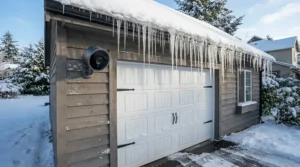
Scenario 1: The rural homeowner (Upper Midwest, detached garage, budget around $300). Lows regularly drop below -15°F, and you can trench or pull Ethernet. This is the case for Amcrest IP8M-T2599EW or Lorex E841CA-E. Wired power sidesteps battery trouble entirely, and the -22°F rating leaves headroom. Add a small NVR or microSD cards and you’ve built a freezeproof outdoor security camera for winter that you can mostly ignore.
Scenario 2: The renter (Chicago or Denver, balcony or porch, no drilling, budget under $150). Winters see single digits but rarely deep subzero, and you want something movable. Blink Outdoor 4 with lithium AAs is the low-fuss answer. If you want more coverage and don’t mind spending a bit more, Eufy SoloCam S340 covers a wider area with pan-tilt and no subscription.
Scenario 3: The cabin owner (high-altitude, sunny but cold, checks in weekly). Winter sun at altitude is strong, so a solar panel earns its keep. Reolink Argus 4 Pro gives a 180° view of the whole front of the cabin. Pair it with a steep panel angle and check the battery during each visit, and plan on a wired option if lows will sit below its rating.
✨ Don’t Miss These Exclusive Deals!
🔍 Take your winter home security to the next level with these carefully selected cameras. Click on any highlighted item to check current pricing and availability. These picks will help you build reliable, always-on coverage your family can count on, even in the deep freeze!
How to Choose a Weatherproof Outdoor Camera for Extreme Cold Climates
Choosing a weatherproof outdoor camera for extreme cold climates comes down to six decisions. Do them in this order and the shortlist writes itself.
- Start with your coldest night, not your average. Look up local record lows. You don’t need a camera for -60°F if your worst night is -5°F, but you do need margin.
- Demand a published numeric minimum. If a listing doesn’t state a low-end temperature, treat that camera as a 32°F product until proven otherwise.
- Pick the power source for the cold. Wired PoE beats lithium AAs, and lithium AAs beat rechargeable lithium-ion packs for cold reliability.
- Check the ingress rating. IP65 is the practical minimum, and IP66 or IP67 is better. See the next sections for what each really tests.
- Count the recurring costs. Cloud plans, replacement batteries, and NVR hardware change the real price.
- Plan placement before purchase. An eave, a sheltered corner, or a south-facing wall changes what rating you truly need.
Each step trims the field. Step one eliminates the 14°F cameras for the far north, step two filters out unrated bargains, and step three decides between wired and wireless. By step four you’ll be down to two or three finalists.
Operating Temperature Range: What the Number Really Means for Winter
The operating temperature range is the span in which a manufacturer guarantees the camera will function as designed. That’s different from the storage range, which describes what the camera survives while switched off. A camera stored at -10°F may be fine sitting in a box but not fine recording on a wall.
Ratings also follow a pattern: powered cameras are rated colder than battery models. Ring’s community staff, for example, state that its outdoor battery-powered devices are rated from -5°F to 122°F, while its powered cameras (like the Floodlight Cam) go down to -22°F. The same logic holds here: Amcrest IP8M-T2599EW and Lorex E841CA-E reach -22°F, and the battery-based cameras stop at -4°F or 14°F.
How much headroom should you leave? A reasonable rule of thumb is about 10°F between your record low and the rated minimum. Anecdotes of cameras running far below their ratings (a Wyze forum user reported operation at -22°F, for instance) are real but unreliable. Warranties and support follow the spec sheet, not forum luck.
IP66 Weather Rating: What It Covers (And What It Doesn’t)
An IP66 weather rating means the enclosure is dust-tight and protected against powerful water jets from any direction. In testing terms, that’s water from a 12.5 mm nozzle at about 100 liters per minute, versus 12.5 liters per minute for IP65. For rain, sleet, and meltwater, that’s overkill in the best sense.
Here’s the nuance most listings skip. Under IEC 60529, a rating with a 7 or 8 as the second digit isn’t automatically better against jets unless it’s dual-coded, because immersion and jet tests measure different things. So IP67 (like the Eufy SoloCam S340) is excellent for temporary submersion, while IP66 (like Reolink Argus 4 Pro) is explicitly tested against jets. For winter, either is plenty.
What the code doesn’t tell you: whether seals stay flexible at -20°F, whether ice loading stresses a bracket, or whether freeze-thaw cycles squeeze moisture past a weak cable gland. The rating covers ingress only. That’s why the cold rating and the IP rating must be read together, and why cable drip loops and connector covers still matter.
Lithium Battery Cold Performance: Why Wireless Cameras Struggle in Winter
Cold slows the chemistry inside a battery. According to Battery University, lithium-ion cells discharge acceptably between roughly -20°C and 60°C (-4°F to 140°F) and can be used down to about -30°C (-22°F) with reduced capacity, because the electrolyte becomes more resistant. Reported capacity losses vary widely by cell chemistry, but double-digit drops in deep cold are common.
For a camera, that means shorter runtime and, in the worst case, a low-battery shutdown on a night when you need footage most. Charging adds a second problem: many lithium-ion packs limit or block charging near freezing for safety reasons. That’s why solar-charged cameras in short, gray, freezing weeks can fall behind even when the panel looks fine.
This is also why Blink Outdoor 4 is clever. Its primary lithium AA cells aren’t recharged at all, and guides consistently note that lithium AAs hold output better in the cold than alkaline cells. By contrast, Reolink Argus 4 Pro and Arlo Pro 5S rely on rechargeable packs, so winter runtime will be shorter than the summer numbers you saw on the box. The practical fix is simple: choose the camera’s rating with margin, keep solar panels clear, and watch battery alerts monthly.
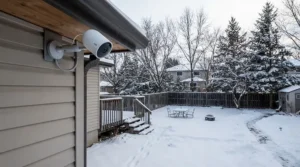
Freezeproof Outdoor Security Camera for Winter: Wired vs Wireless
If “freezeproof” is the goal, power source is the main variable. Here’s how the three common approaches compare.
| Feature | Wired PoE | Wireless Lithium AA | Wireless Rechargeable / Solar |
|---|---|---|---|
| Cold margin | Best (to -22°F on rated models) | Good (-4°F rated) | Moderate (-4°F to 14°F rated) |
| Winter maintenance | Almost none | Swap batteries yearly or so | Clear panels, monitor charge |
| Install effort | Highest (cable run) | Lowest | Low |
| Recording reliability | Highest | High | Moderate in short, gray winters |
| Best example | Amcrest IP8M-T2599EW | Blink Outdoor 4 | Eufy SoloCam S340 |
Looking at the table, wired power wins on every reliability measure, and the cost is a one-time cable job. Wireless wins on flexibility but trades away cold margin. If you’re torn, use Reolink RLC-810A as a middle path: wired reliability at a wireless-camera price, as long as your lows stay inside its 14°F rating.
Outdoor Camera That Works in Subzero Temperatures: What to Expect in Real-World Performance
Specs tell you whether a camera turns on. Real-world performance is about what the footage looks like at 3 a.m. in a blizzard. I can’t claim hands-on testing, so treat the following as reasoning from physics and spec sheets rather than test results.
First, snow reflects infrared light strongly, so night footage on a white yard can look washed out, and falling flakes near the lens can light up like confetti. Cameras with a wider view and HDR, like Lorex E841CA-E, tend to handle bright-scene balance better. Second, a camera mounted under an eave sees less direct snow and frost, which usually means cleaner footage and fewer false alerts. Third, expect slower app response on wireless models in deep cold, since radios and batteries are working harder.
If you want an outdoor camera that works in subzero temperatures, the safest expectation is this: wired, rated, and sheltered will beat wireless, borderline, and exposed every time. Set alerts for low battery, check footage after the first major storm, and adjust angles to cut reflective glare.
Long-Term Cost and Maintenance: What a Camera Really Costs You
The sticker price is only the first line of the bill. Over three winters, a $60 camera that needs subscription fees can cost more than a $150 camera with local storage.
- Subscriptions: Arlo Pro 5S needs a paid Arlo Secure plan for cloud recording after its trial. Eufy SoloCam S340 and the PoE models record locally.
- Batteries: Blink Outdoor 4 needs a fresh pair of lithium AAs roughly once a year or two. That’s pocket change compared with a failed built-in battery on Reolink Argus 4 Pro, which isn’t user-replaceable.
- Infrastructure: PoE cameras need a switch, injector, or NVR. It’s an upfront cost, but it also means a decade of boring reliability.
My analytical read: for a permanent home in a harsh climate, the wired option usually wins on total cost of ownership. For a temporary or rental setup, wire-free wins on flexibility, as long as you budget for batteries and plan fees.
Common Mistakes When Buying a Cold-Climate Camera
A few pitfalls account for most winter regrets.
- Trusting “weatherproof” without a number. Weatherproof refers to water. Cold is a separate spec.
- Buying to the edge of the rating. A -4°F camera in a -4°F town has zero margin.
- Ignoring the power source. Rechargeable cells and short winter days are a poor match.
- Forgetting the NVR or PoE gear. Wired cameras aren’t plug-and-play without a power source.
- Mounting in the wrong place. Exposed corners eat wind, snow, and frost. A sheltered eave doesn’t.
- Skipping monthly checks. Battery status is easy to ignore until a camera goes dark.
Avoid those six and you’ll beat most buyers to a reliable winter setup.
Frequently Asked Questions
❓ What temperature is too cold for an outdoor security camera?
❓ Do battery-powered security cameras work in freezing weather?
❓ Is an IP66 weather rating enough for snow and ice?
❓ Can a PoE camera handle colder weather than a wireless one?
❓ Does wind chill affect security cameras?
Conclusion: Match the Rating to Your Coldest Night
The best weatherproof outdoor camera for extreme cold climates isn’t the one with the flashiest resolution. It’s the one whose published rating leaves comfortable room above your coldest night. For brutal winters, Amcrest IP8M-T2599EW and Lorex E841CA-E are the safest picks on paper thanks to their -22°F ratings and wired power. For moderate cold, Reolink RLC-810A offers the best budget value. If you need wire-free flexibility, Blink Outdoor 4, Eufy SoloCam S340, Arlo Pro 5S, and Reolink Argus 4 Pro each fit a different trade-off between cost, coverage, and cold margin.
Read the operating temperature range before the megapixels, pair it with at least an IP66 weather rating, and respect lithium battery cold performance if you’re going wireless. Do that, and your freezeproof outdoor security camera for winter will quietly do its job while you stay warm indoors. When shopping for an outdoor camera that works in subzero temperatures, remember: the spec sheet is your friend, and optimism is not a heating system.
Recommended for You
- Battery Outdoor Security Camera for Renters No Drilling: 7 Best 2026
- Outdoor Camera Mounting Accessories for Gutters and Eaves: Top 7 2026
- Color Night Vision Outdoor Camera for Dark Rural Property 7 Best 2026
Disclaimer: This article contains affiliate links. As an Amazon Associate, I earn from qualifying purchases. If you purchase products through these links, we may earn a small commission at no additional cost to you.
✨ Found this helpful? Share it with your friends! 💬🤗
