In This Article
A color night vision outdoor camera for dark rural property is a weatherproof security camera that keeps recording full-color video in very low light. It does this with a large sensor, a wide-aperture lens, and often a small built-in spotlight. Unlike a basic infrared camera, it preserves clothing, vehicle, and skin colors, so the footage is far easier to use.
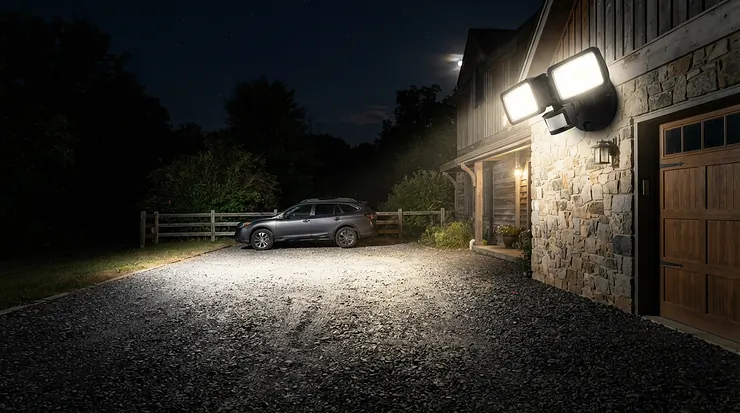
Out here, dark means dark. No streetlights. No neighbor’s porch glow. Just a few stars and whatever the moon feels like contributing. Photographers and camera makers measure that gloom in lux, the unit of illuminance, and a moonless rural night sits at a tiny fraction of one lux. Most consumer cameras were engineered for suburban dusk. Mount one on a barn, and it flips to grainy black-and-white infrared that turns your pickup truck into a gray smudge.
The good news is that color night vision has grown up fast. A solid color night vision outdoor camera for dark rural property no longer demands a four-figure commercial rig. Big sensors, F/1.0 to F/1.6 lenses, and clever spotlight logic have trickled down to cameras in the low-to-mid hundreds of dollars.
The bad news? Marketing terms are slippery. “Starlight,” “ColorX,” and “color night vision” can mean wildly different things on a field with zero ambient light.
This guide is built from manufacturer spec sheets, published professional reviews, and the aggregated tone of customer feedback. It is not built on a weekend of me wandering a pasture with a flashlight. We’ll compare seven real cameras, untangle infrared vs color night vision, decode the starlight sensor and low lux sensitivity, and show you where to mount things so the footage is actually useful.
Quick Comparison: Color Night Vision Cameras for Rural Property at a Glance
| Camera | Night Vision Approach | Power | Best For |
|---|---|---|---|
| Reolink Argus 4 Pro | ColorX low-light color, spotlights as backup, no IR | Battery + solar | Reolink Argus 4 Pro: wide-view, wire-free spots |
| Reolink Duo 3 PoE | Spotlight color + infrared | PoE (one cable) | Reolink Duo 3 PoE: driveways and barn aprons |
| eufyCam S330 | Starlight color + infrared, spotlight | Battery + built-in solar | eufyCam S330: no-subscription, multi-camera yards |
| Lorex W881AAD | Color booster with LED + infrared | AC plug-in | Lorex W881AAD: powered sheds and porches |
| Ring Spotlight Cam Pro | Color night vision + LED spotlights | Battery, solar, plug-in or wired | Ring Spotlight Cam Pro: Ring-ecosystem homes |
| Wyze Cam v4 | Spotlight-assisted color | Plug-in | Wyze Cam v4: tight budgets |
| Tapo C120 | Starlight-style color, wired | Plug-in | Tapo C120: cheap secondary angles |
Look at the pattern in the table. Only the Reolink Argus 4 Pro leans entirely on sensor sensitivity for color, while most of the others pair color with a small light or an infrared fallback. That distinction matters enormously on a property with zero ambient light. Cameras that need a bit of glow to stay in color will quietly drop into black-and-white once the sun and moon both clock out. If your acreage is truly pitch black, prioritize the infrared fallback or a bigger sensor over the headline “color” claim.
💬 Just one click — help others make better buying decisions too!😊
Top 7 Color Night Vision Outdoor Cameras for Dark Rural Property: Expert Analysis
All seven picks below are real, currently listed models. Prices are ranges at the time of research (November 2026), so check current pricing before you buy. Review sentiment is described honestly, with sources named where I could verify them.
1. Reolink Argus 4 Pro — spotlight-free color from a big sensor
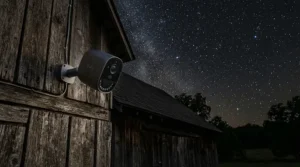
The headline trick here is ColorX, Reolink’s low-light color mode. It relies on a 1/1.8-inch sensor behind an F/1.0 lens instead of blasting the scene with light.
On paper, that sensor and lens combination is rated down to roughly 0.0005 lux, against about 0.003 lux for a typical outdoor camera. In practice, that means a moonlit barnyard stays in color without a visible spotlight announcing the camera’s position. The dual-lens design stitches a 4K-class image (5120×1440) into a 180° panorama, so one camera can cover a whole driveway apron. Power comes from a 5000mAh battery with solar-panel support, which is a gift when you can’t trench a cable to the back forty.
Here is the honest catch. The spec sheet lists no infrared night vision at all, only spotlights as backup for near-total darkness. So if your property is truly black, the camera will lean on those lights.
Digital Camera World’s Argus 4 Pro review praised its good-looking full-color nocturnal footage. Mighty Gadget’s reviewer likewise recommended it strongly. I couldn’t verify a large, aggregated customer-review pool, so check the current review tab for long-term battery reports.
Pros:
- ✅ Full-color night footage without a visible spotlight
- ✅ 180° dual-lens view covers wide yards
- ✅ Solar-ready battery suits no-wiring locations
Cons:
- ❌ No infrared fallback for pitch-black zones
- ❌ Relies on solid Wi-Fi at the mounting spot
Expect a price in roughly the $150-$200 range depending on bundle. For wire-free coverage of an open yard, that’s strong value.
2. Reolink Duo 3 PoE — 16MP panorama on a single cable
Think of this as two cameras fused into one weatherproof body. Two 1/2.7-inch sensors behind F/1.6 lenses stitch into a 180° view at 16MP (7680×2160), which is how you read a license plate across a gravel lot.
Power over Ethernet delivers electricity and data through one cable. For rural installs, that’s the difference between “works through every winter” and “dropped off Wi-Fi again.” The IP67 rating handles rain, snow, and mud-season hose-downs. Night vision is dual-mode: spotlight-assisted color or discreet black-and-white infrared. The Wi-Fi sibling lists infrared out to about 30 meters and eight 5W spotlights, so expect similar muscle here, but verify on the PoE data sheet.
My analytical take is simple. The Reolink Duo 3 PoE suits owners willing to run one Ethernet cable and who want an NVR-style system with zero monthly fees. The panorama also reduces the number of cameras you must buy and aim.
Reolink’s own review reports commendable night vision and a handful of visible details in color mode. That’s a manufacturer source, so weigh it accordingly. Independent write-ups, such as Mighty Gadget’s comparison against the Duo 2, focus on the resolution jump. I couldn’t verify a large customer-review sample.
Pros:
- ✅ One cable for power and data
- ✅ 16MP panorama replaces two cameras
- ✅ Both color and infrared night modes
Cons:
- ❌ Needs a cable run and a PoE injector or switch
- ❌ High resolution eats storage quickly
Plan on roughly $150-$250 depending on bundle. If you can pull a cable, it’s the sturdiest choice on this list.
3. eufyCam S330 — starlight color with solar power and no monthly fee
Eufy’s pitch is “Forever Power”: a built-in solar panel that needs only about two hours of daily sun, plus a base-year battery of roughly 365 days. In shady hollows or dark winter months, that claim deserves a skeptical eye. But for open pasture mounting, it’s a real convenience.
Under the hood, you get a 4K sensor, an F/1.4 aperture, a 135° field of view, and what eufy calls a Starlight system. Night vision covers both color and infrared out to about 25 feet, with a 100-lumen spotlight. A 25-foot range is the limiting spec for rural use. It’s great for a porch or barn door, and less helpful across an open yard.
The eufyCam S330 requires the HomeBase 3 hub, which supplies local storage that can expand up to 16TB through an external drive. For anyone with slow rural upload speeds, local storage is a major advantage. Facial recognition runs on-device through eufy’s BionicMind AI, so you aren’t paying a subscription for it.
A German outlet (techstage) scored the S330 kit “very good” at 90/100, praising the colour night vision, efficient solar panel, and AI detection. I couldn’t verify broad customer-review aggregates beyond that.
Pros:
- ✅ Local storage with no monthly fee
- ✅ Solar panel extends battery life
- ✅ Starlight color plus infrared fallback
Cons:
- ❌ 25-foot night range is short for open ground
- ❌ Requires the HomeBase hub
Single add-on cameras and multi-camera kits run roughly from the low $100s to the mid-$500s. For a cluster of buildings within range of one hub, it’s a smart system.
4. Lorex W881AAD — 4K spotlight camera with its own storage
Lorex pairs an 8MP sensor with an F/1.6 lens and a 140° view. It also includes a bright, color-assignable LED band and an infrared fallback (855nm, about 32 feet).
This is where honesty helps you. Lorex states color night vision “works best with the help of ambient lighting.” In conditions that are too dark, the camera switches to black-and-white infrared. Its Color Night Vision Booster uses the camera’s own LED to keep color alive, with a listed minimum color illumination of 0 lux when that light is on. In plain English, the camera makes its own light.
The Lorex W881AAD plugs into AC power, carries IP65 weatherproofing for -20°C to 55°C, and includes 32GB of built-in storage. Wi-Fi 6 supports faster connections, and there’s no monthly fee. Smart detection tags people, vehicles, animals, and packages.
Lorex’s own review summary says customers praise image quality, setup ease, and the app. That’s the manufacturer’s summary, so treat it as directional.
Pros:
- ✅ 4K detail with a 140° view
- ✅ Built-in storage, no subscription required
- ✅ Dual fallback: LED color or infrared
Cons:
- ❌ AC power limits placement
- ❌ Infrared reach tops out near 32 feet
Pricing swings between about $130 and $220 with promotions. For a powered shed, porch, or garage, it’s a capable all-rounder.
5. Ring Spotlight Cam Pro — the ecosystem pick with smart motion zones
Ring’s strength is software. The camera offers 3D Motion Detection, Bird’s Eye View (an overhead map of an intruder’s path), custom motion zones, and Audio+ two-way talk. It also includes two LED spotlights and a siren.
Video resolution depends on the model year. Current listings call it Retinal 2K, while earlier versions were 1080p HDR with a 140° by 80° field of view. Four power options exist (battery, plug-in, solar, wired), which helps rural flexibility. The listing notes that advanced features draw more battery power, so budget for more frequent charging.
Here’s what the spec sheet quietly tells you. Motion zones are listed up to about 30 feet, which is great on a porch and limiting across a paddock. Color night vision relies on the spotlights and ambient glow. This is a “deter and identify near the house” tool, not a perimeter sentry.
I couldn’t verify a robust independent review sample for this exact current model, so read recent buyer feedback on battery life. Ring typically places longer recorded-video history behind a subscription plan, so check current terms.
Pros:
- ✅ Four power options fit awkward spots
- ✅ Bird’s Eye View shows intruder paths
- ✅ Built-in siren and dual spotlights
Cons:
- ❌ Motion zones reach only about 30 feet
- ❌ Recorded video history may require a plan
Expect roughly $150-$250 depending on power type and model. It makes sense if you already live in Ring’s world.
6. Wyze Cam v4 — the budget starter with 2.5K and no subscription
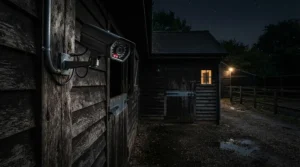
Cheap does not have to mean useless. This plug-in camera records at 2.5K QHD and switches to enhanced color night vision using a built-in spotlight when motion triggers it.
That trigger-based lighting is smart for a farmhouse. The spotlight fires only when something moves, which saves power and avoids a permanent glow that spooks the horses. A roundup I reviewed highlighted that it delivers 2.5K color night vision without a subscription, and rated it around 4.4 out of 5. That’s one listicle’s rating rather than a verified customer average.
The tradeoff is range. A small built-in spotlight lights a porch or a barn door. It does not light a field. And it’s plug-in only, so you need an outlet and a reliable Wi-Fi signal at the mounting spot.
My take: buy this for the spots where you’d otherwise buy nothing. A chicken coop, a side door, or a workshop entrance can each get a camera for the price of a nice dinner. Skip it as your only perimeter camera.
Pros:
- ✅ Very low entry price
- ✅ 2.5K video with spotlight-assisted color
- ✅ No subscription required for core use
Cons:
- ❌ Needs outlet power and Wi-Fi
- ❌ Short effective night range
It typically sells well under $50, so the value verdict is easy.
7. Tapo C120 — wired 2K color night vision at a bargain
TP-Link’s budget line often punches above its price, and the Tapo C120 fits the pattern. A roundup I checked lists 2K QHD resolution, starlight-style color night vision, free AI detection, and an IP66 weather rating.
“Starlight” here signals a more light-sensitive sensor and lens combination, not magic. In a no-streetlight yard, expect color to hold near any ambient glow and fall back toward monochrome in true blackness. The wired design suits a barn with an outlet, but not an out-of-range gate.
The value angle is free on-camera AI detection, which spares you a subscription for basic person alerts. For rural owners with slow upload speeds, local microSD recording (verify the slot and card limits on the current listing) is more practical than cloud footage.
I couldn’t confirm a deep aggregated review pool for this model, so lean on recent buyer feedback about night image quality. Stack two or three of these around outbuildings, and you’ve built a surprisingly capable mesh for the cost of one premium camera.
Pros:
- ✅ 2K detail at a budget price
- ✅ Free AI detection for basic alerts
- ✅ IP66 weather resistance
Cons:
- ❌ Wired power limits placement
- ❌ Color range fades in true darkness
Plan on roughly $25-$50. It’s a great secondary-angle camera.
Top 7 Spec Snapshot
| Camera | Resolution | Lens / Sensor | Low-Light Claim | Weather Rating | Price Range | Best For |
|---|---|---|---|---|---|---|
| Reolink Argus 4 Pro | 5120×1440 | F/1.0, 1/1.8″ | ~0.0005 lux | IP66 | ~$150-$200 | Reolink Argus 4 Pro: wire-free panoramas |
| Reolink Duo 3 PoE | 7680×2160 (16MP) | F/1.6, 1/2.7″ dual | Color + IR | IP67 | ~$150-$250 | Reolink Duo 3 PoE: cabled driveways |
| eufyCam S330 | 4K | F/1.4 | Starlight + IR (25 ft) | IP67 | ~$100s-$500s kit | eufyCam S330: hub-based clusters |
| Lorex W881AAD | 4K (8MP) | F/1.6, 1/2.8″ | 0 lux with LED on | IP65 | ~$130-$220 | Lorex W881AAD: powered sheds |
| Ring Spotlight Cam Pro | 2K (current) | Not stated | Color + spotlights | Not verified | ~$150-$250 | Ring Spotlight Cam Pro: Ring homes |
| Wyze Cam v4 | 2.5K | Not stated | Enhanced color + spotlight | Not verified | Under ~$50 | Wyze Cam v4: budget coverage |
| Tapo C120 | 2K | Not stated | Starlight-style color | IP66 | ~$25-$50 | Tapo C120: extra angles |
Notice that “not stated” appears more than once, and that’s the point. Only a few makers publish real lux and aperture numbers, so those that do (Reolink Argus 4 Pro, Reolink Duo 3 PoE, Lorex W881AAD) are easier to judge on paper. Where specs are missing, I’d weigh independent footage reviews more heavily. A lux figure is also not an apples-to-apples test, because different brands measure it differently. Treat the numbers as a rough ranking, not gospel.
✨ Don’t Miss These Exclusive Deals!
🔍 Take your rural security to the next level with these carefully selected cameras. Click on any highlighted product to check current pricing and availability. A well-placed camera helps you build the clear, color footage you can actually act on, and the peace of mind that comes with it! 🌙
Night Vision Security Camera for Yard Without Streetlights: A Placement and Setup Guide
Choosing the camera is half the battle. Where you put it decides whether you get a usable face or a ghostly smear.
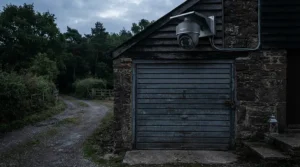
A night vision security camera for yard without streetlights has one enemy above all: reflected glare. Mount it too close to a wall or eave, and its own infrared or spotlight bounces back as a washed-out haze. Keep a few inches of clearance and aim the lens slightly downward.
Here’s a practical setup sequence:
- Walk the property after dark first. Stand where the camera will go and note what’s lit, what isn’t, and where moonlight lands.
- Mount at 9-10 feet. High enough to be tamper-resistant, low enough to see faces.
- Aim along the path, not across it. A person walking toward the lens shows a face; one walking across shows a profile.
- Test the signal. Check Wi-Fi strength with your phone at the mounting spot before drilling. Weak signal causes dropped clips.
- Set motion zones. Mask waving trees and roads to cut false alerts.
- Choose local recording. Rural upload speeds are often slow, so microSD or a hub is gentler than cloud upload.
In the first month, schedule a quick “lens check” once a week. Spider webs, dust, and condensation are the top reasons night footage suddenly looks worse. Infrared LEDs attract insects, and insects attract spiders. That’s another point for the Reolink Argus 4 Pro, which skips infrared entirely.
Real-World Scenarios: Which Camera Fits Which Property
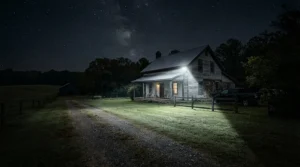
Specs are abstract. Land is concrete. Here are three typical profiles and the logic behind each match.
Scenario 1: The five-acre homesteader with a long gravel driveway. Budget is moderate, there’s an outbuilding 150 feet from the house, and power runs only to the garage. A Reolink Duo 3 PoE on the garage covers the driveway in one panorama. A solar-ready Reolink Argus 4 Pro goes on the far outbuilding where no cable reaches. Total cost lands in the low-to-mid $300s.
Scenario 2: The weekend-cabin owner, 90 minutes from town. Internet is spotty, visits are occasional, and the main fear is break-ins while away. Local storage matters more than anything. A eufyCam S330 kit with a hub and solar-assisted cameras keeps footage on-site without monthly fees. The 25-foot night range is enough for doors and windows.
Scenario 3: The small-farm owner with several outbuildings and a tight budget. Outlets exist at the barn, coop, and shed. Three Tapo C120 units plus one Wyze Cam v4 cover the doors for well under $200 combined. A Lorex W881AAD on the main barn adds a 4K anchor view.
The pattern across all three is the same. Match the power source to the location first, then match the night-vision method to the darkness. That order saves more money than any discount.
Problem and Solution: Fixing Night Footage Headaches
Even the best camera misbehaves sometimes. Here are the most common rural-night issues and specific fixes.
Problem 1: Footage turns black-and-white. Cause: ambient light is below the camera’s color threshold. Fix: add a small, low-wattage motion light nearby, or choose a camera with its own LED, such as the Lorex W881AAD.
Problem 2: Moths and insects flood the clip. Cause: infrared LEDs and light attract bugs. Fix: mount the camera away from the porch light and favor spotlight-free options like the Reolink Argus 4 Pro.
Problem 3: Glare washes out the image. Cause: the camera’s own light is reflecting off a nearby surface. Fix: add clearance from walls and angle the lens down.
Problem 4: Constant false alerts from wildlife. Cause: deer, raccoons, and wind-blown brush. Fix: tighten motion zones, lower sensitivity, and use person-only alerts, available on cameras like the Ring Spotlight Cam Pro and Tapo C120.
Problem 5: Random disconnects. Cause: weak Wi-Fi at the far buildings. Fix: add a mesh node or switch to a wired option like the Reolink Duo 3 PoE.
How to Choose a Color Night Vision Outdoor Camera for Dark Rural Property
Use these seven steps as a decision checklist. Each one filters the field.
- Measure your darkness. Visit at night. If you see any glow, a color-first camera can work. If it’s pitch black, require an infrared fallback or a self-lit color mode.
- Pick the power source. Outlet, PoE cable, or solar battery decides your shortlist before anything else.
- Check sensor size and aperture. A 1/1.8-inch sensor with F/1.0 gathers far more light than a small sensor at F/2.0.
- Read the lux claim carefully. Lower is better, but check whether it assumes the supplemental light is on.
- Confirm night range. A 25-foot reach suits doors. A 100-foot reach suits driveways.
- Choose storage that fits your internet. Local microSD or a hub beats cloud for slow rural upload.
- Verify weather ratings. Look for IP65 or higher, and check the operating temperature range for your winters.
Infrared vs Color Night Vision: Which Wins on a Rural Property?
The infrared vs color night vision debate comes down to one question: do you need to see details or just shapes?
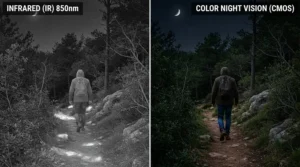
Infrared cameras illuminate the scene with invisible LEDs and render it in monochrome. They work in total darkness and reach far. Color cameras gather visible light, either from the environment, a bigger sensor, or a built-in lamp. They render clothing, vehicles, and skin tones.
| Feature | Infrared | Color (self-lit) | Color (low-light sensor) |
|---|---|---|---|
| Works in total darkness | Yes | Yes, with light on | Limited |
| Image type | Black-and-white | Full color | Full color |
| Typical range | Longest | Short-to-medium | Medium |
| Draws attention | No | Yes | No |
| Attracts insects | More | Some | Less |
| Best For | Perimeter fields | Doors and driveways | Moonlit open yards |
The table reveals a trade rather than a winner. Infrared owns the dark perimeter, color owns identification at close range, and a low-light sensor splits the difference when there’s a little ambient light. For most rural properties, the smartest answer is a mix: infrared-capable cameras along the edges and color cameras at doors, gates, and driveways.
Outdoor Camera with Spotlight and Color Night Vision: Friend or Foe?
An outdoor camera with spotlight and color night vision gets you vivid footage anywhere, because it manufactures its own light. The benefits are deterrence and clarity. Many intruders leave when a light snaps on.
The downsides are battery drain, wildlife triggers, and a camera that announces itself. Use motion-triggered spotlights, as on the Wyze Cam v4, to limit the glare, or choose spotlight-free color like the Reolink Argus 4 Pro for stealth.
Starlight Sensor and Low Lux Sensitivity: Reading Between the Spec-Sheet Lines
Two phrases dominate the marketing: starlight sensor and low lux sensitivity. They sound technical, and they are, but they’re also slippery.
What a Starlight Sensor Actually Is
A starlight sensor is simply a more light-sensitive image sensor, usually larger and paired with a wide-aperture lens. It’s the same family of idea behind Hikvision’s ColorVu approach, which renders color down to about 0.0005 lux, roughly equal to a moonless, starlit night. The eufyCam S330 and Tapo C120 use “starlight” branding. Bigger sensors and brighter lenses are the real hardware behind the label.
Low Lux Sensitivity: The Number Behind the Hype
Low lux sensitivity is the minimum light level at which a camera still delivers a usable image. Lower numbers mean better performance. For context, Reolink cites about 0.0005 lux for the Reolink Argus 4 Pro versus roughly 0.003 lux for an average outdoor camera.
Here’s the caveat. Lux ratings aren’t tested uniformly. One camera-forum veteran cautions that trademarked “color” labels can hide how the numbers were measured. My advice is to use lux as a tiebreaker, then confirm with independent night footage. Also check whether a quoted 0 lux relies on the camera’s own LED, as the Lorex W881AAD does.
Features That Actually Matter (And Those That Don’t)
Spec sheets are crowded. Here’s a quick filter, based on how rural properties actually behave.
What matters: sensor size and aperture, a real infrared or self-lit fallback, a weather rating suited to your climate, local storage, and a power source you can maintain. A solid Wi-Fi signal at the mounting point matters more than any megapixel count.
What matters less: headline megapixels beyond 4K, since a bigger file doesn’t fix a dark scene. Fancy color-changing light bands are fun but not security-critical. And “AI” labels vary widely, so look for person-and-vehicle filtering rather than vague promises.
The Reolink Duo 3 PoE‘s 16MP is impressive for reading plates across a lot, but its F/1.6 lens and 1/2.7-inch sensor tell you more about night quality than the resolution does. Always read the lens before the megapixels.
Common Mistakes When Buying Rural Night Cameras
Most regrets come from the same handful of errors.
Trusting the word “color” blindly. Many cameras say color night vision but need ambient light. In a black field, they revert to infrared. Read the fine print, like Lorex’s own note about ambient lighting.
Ignoring power logistics. A camera is useless with a dead battery. Plan outlets, PoE, or solar before ordering.
Buying one camera instead of layers. A single wide view helps, but overlapping angles on doors and gates give you identification plus context.
Skipping the dark-night site walk. Moonlight changes with the calendar. A spot that looked fine at dusk may be pitch black at 2 a.m.
Forgetting storage and upload limits. Cloud-only cameras choke on slow rural internet. Favor local storage.
Mounting too low. Cameras within reach get stolen or tilted. Nine to ten feet is a safer height.
Long-Term Cost and Maintenance
The sticker price is only chapter one. A Wyze Cam v4 costs a fraction of a premium camera, but five of them means five outlets and five Wi-Fi checks. A eufyCam S330 kit costs more up front, yet local storage and solar charging reduce ongoing costs.
Subscriptions are the sneaky expense. Several cameras here (including the Lorex W881AAD, eufyCam S330, and Tapo C120) emphasize no monthly fee for core features, while Ring typically places longer video history behind a plan. Over three years, that difference can exceed the camera’s price.
Maintenance is light but real:
- Wipe lenses monthly, and weekly in spider season.
- Re-seat solar panels after storms.
- Check battery levels before winter.
- Update firmware, since night-image tuning often improves over time.
One test I’d point to is The Smart Home Hookup’s comparison of color night vision cameras. It notes that skipping infrared LEDs also means fewer bugs and fewer spider webs on the lens. That’s an easy-to-miss maintenance win.
Safety, Privacy, and Legal Basics
Cameras on rural land come with responsibilities. Keep your lens pointed at your own property, and avoid capturing neighbors’ windows or private areas. Rules about recording audio differ by state, so check your local law before enabling two-way audio or continuous audio recording.
Post a simple “camera in use” sign. It’s courteous, it deters, and in some places it’s expected. Secure your accounts with strong passwords and two-factor authentication, and keep firmware updated. A camera that guards your barn shouldn’t also be a window into your living room for strangers.
Finally, don’t aim high-power spotlights at roads, because glare can distract drivers. A downward angle solves both the legal and the practical problem.
FAQ: Color Night Vision Cameras for Rural Property
❓ Do color night vision cameras work in total darkness?
❓ How far can a color night vision camera see on an open property?
❓ Is a bigger sensor better than more megapixels at night?
❓ Can I run a camera without Wi-Fi on a remote property?
❓ Will a built-in spotlight scare wildlife or alert intruders?
Conclusion: Pick the Darkness First, Then the Camera
Dark rural property punishes lazy camera choices. The right pick starts with an honest look at how black your nights really are, then moves to power, range, and storage. After that, the brand matters less than you’d think.
If you want wire-free wide coverage with strong low-light color, the Reolink Argus 4 Pro is the standout. If you can pull a cable, the Reolink Duo 3 PoE is the sturdiest. The eufyCam S330 wins for hub-based, no-fee clusters, and the Lorex W881AAD is a capable powered all-rounder. The Ring Spotlight Cam Pro suits Ring households. For tight budgets, the Wyze Cam v4 and Tapo C120 let you cover extra doors for very little.
Remember the golden rule: color is a bonus, identification is the goal. Layer infrared at the edges, color at the doors, and keep the lenses clean. Your future self, reviewing 2 a.m. footage with a coffee, will thank you.
Recommended for You
- Battery Outdoor Security Camera for Renters No Drilling: 7 Best 2026
- Outdoor Camera Mounting Accessories for Gutters and Eaves: Top 7 2026
- Weatherproof Outdoor Camera for Extreme Cold Climates: 7 Best (2026)
Disclaimer: This article contains affiliate links. As an Amazon Associate, I earn from qualifying purchases. If you purchase products through these links, we may earn a small commission at no additional cost to you.
✨ Found this helpful? Share it with your friends! 💬🤗
